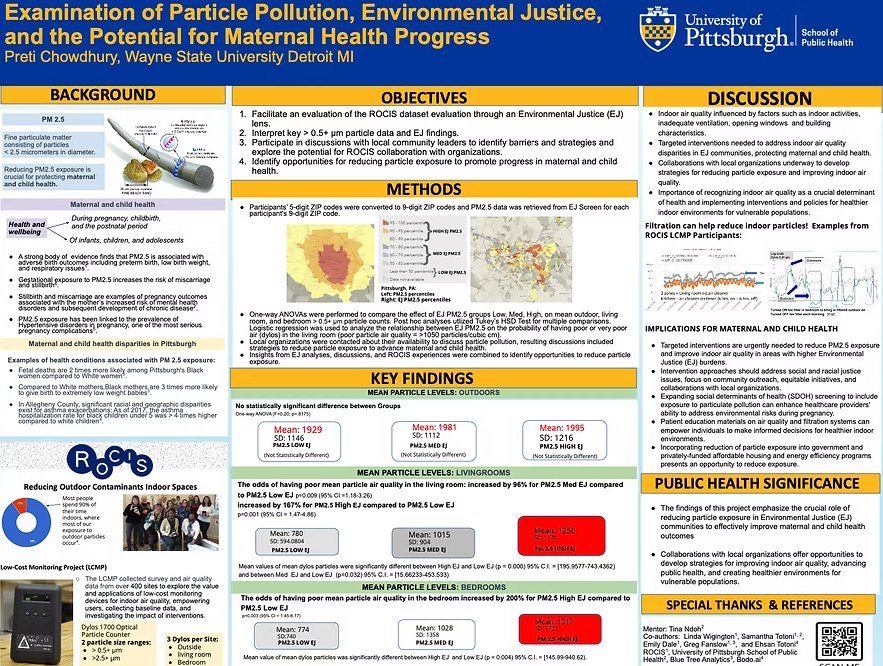
This research investigated how fine particulate matter (PM2.5) exposure and Environmental Justice (EJ) factors affect maternal and child health outcomes in Pittsburgh, PA — using data from the Reducing Outdoor Contaminants in Indoor Spaces (ROCIS) Low-Cost Monitoring Project.
Background & Problem
PM2.5 exposure is directly linked to adverse maternal and child health outcomes — including preterm birth, low birth weight, stillbirth, and miscarriage. Among Pittsburgh's Black women, these disparities are three times more pronounced than in white women, reflecting deep environmental justice inequities.
The study used the ROCIS project's low-cost monitoring infrastructure to collect indoor and outdoor particle data in homes, examining how EJ classification (High vs. Low EJ burden) shapes exposure levels and health risk.
Objectives
- Evaluate the ROCIS dataset through an Environmental Justice (EJ) lens
- Interpret PM2.5 (> 0.5 µm) particle data and link it to EJ findings
- Identify barriers and strategies for ROCIS collaboration with local community leaders
- Identify opportunities for reducing particle exposure to promote maternal and child health progress
Methods
- Participants' 5-digit ZIP codes were converted to 8-digit ZIP codes; PM2.5 data retrieved from EJ Screen
- One-way ANOVAs compared PM2.5 levels across High EJ, Med EJ, and Low EJ groups
- Post-hoc Tukey HSD tests examined pairwise differences in particle levels across outdoor, living room, and bedroom environments
- Logistic regression assessed the relationship between PM2.5 EJ group and probability of having poor or very poor air quality (particle size > 1055 articles/cm)
- Local organizations were engaged to identify opportunities to reduce exposure and discuss findings
Key Findings
Outdoors: No statistically significant difference in mean particle levels across EJ groups (Mean ~1929–1995), suggesting similar baseline outdoor exposure across the sample.
Living Rooms: The odds of having poor mean particle air quality increased by 96% for PM2.5 Med EJ and 167% for PM2.5 High EJ compared to Low EJ — indicating indoor environments in higher-burden areas are significantly more polluted.
Bedrooms: The odds of poor air quality increased by 200% for PM2.5 High EJ compared to Low EJ (p=0.004), with mean dylos particles significantly different between High and Low EJ groups.
Discussion & Public Health Significance
- Indoor air quality is influenced by indoor activities, insulation quality, opening windows, and building characteristics — all shaped by EJ factors
- Targeted interventions to address indoor air quality disparities in EJ communities are urgently needed
- Filtration can meaningfully reduce indoor PM2.5 — the ROCIS project demonstrated this with participants
- Collaborations with local organizations are underway to develop strategies improving indoor air quality and creating healthier environments for vulnerable populations